
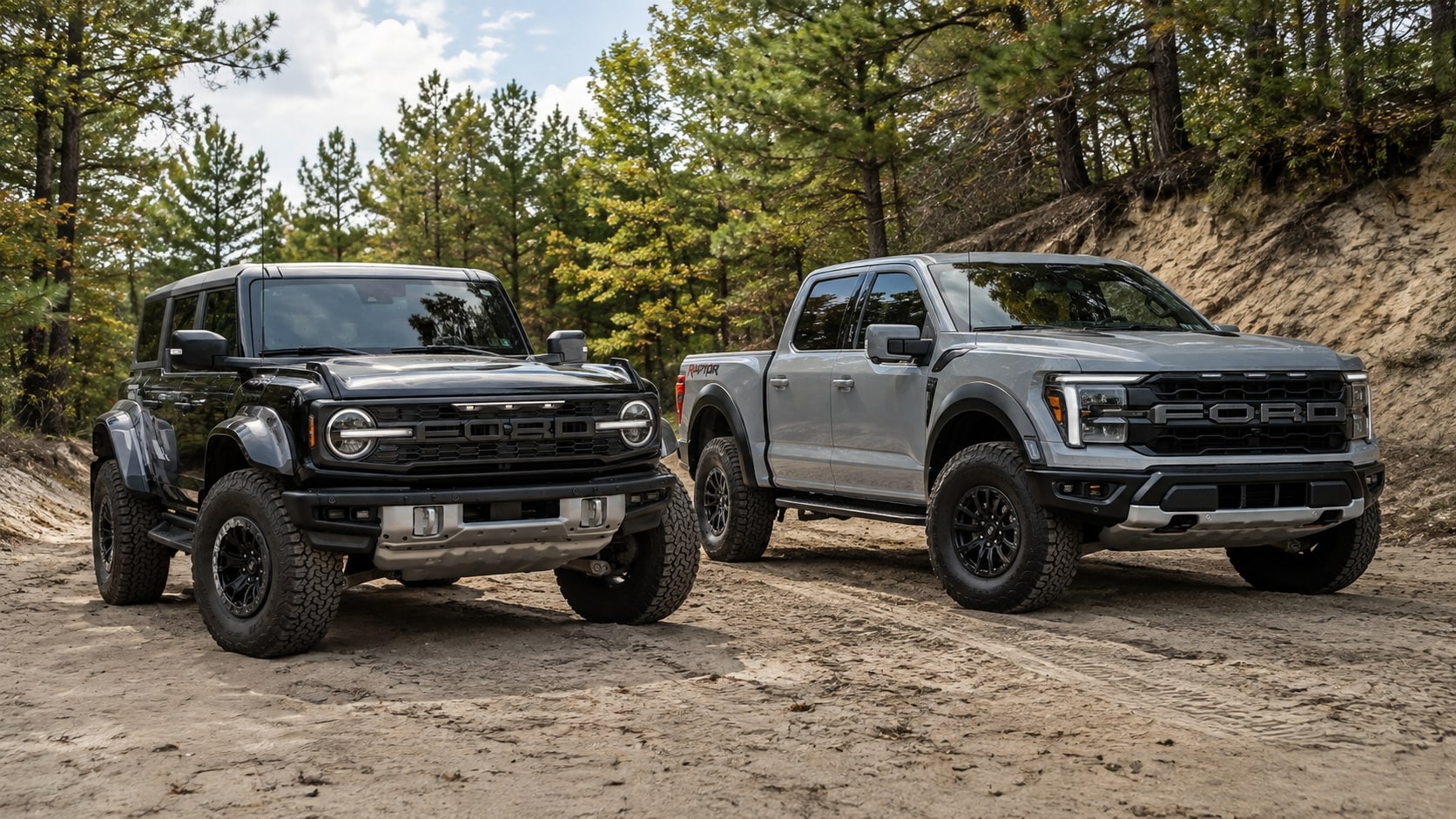
 Bronco Raptor vs F-150 Raptor: Comparing Ford Performance Off-Road Champions
If you are checking out high-performance trucks around Ephrata and Lancaster County, the Raptor name is about as good as it gets. But when you line up a Bronco Raptor next to an F-150 Raptor, you are looking at two completely different machines designed for two distinct off-road styles. Both share that iconic Ford Performance DNA, but they go about conquering dirt trails and highways in very different ways.
What Drives These Off-Road Beasts Under the Hood
Bronco Raptor Engine and Power Figures
Under the hood of the Bronco Raptor, you will find a 3.0-liter EcoBoost V6 engine. Ford actually used this engine platform because the larger 3.5-liter EcoBoost simply could not fit inside the Bronco engine compartment. Shared with performance models like the Ford Explorer ST and Lincoln Aviator, as well as its sibling the Ranger Raptor, this twin-turbo engine is specially tuned to pump out 418 horsepower and 440 pound-feet of torque. Because the Bronco weighs in around 5,760 pounds, that engine makes this lighter vehicle scoot down the road in a hurry, especially when you throw it into sport mode.
F-150 Raptor Engine and Output
The full-size F-150 Raptor brings out the bigger guns with a 3.5-liter high-output EcoBoost V6. It lays down 450 horsepower and 510 pound-feet of torque. Even though the F-150 Raptor is heavier at around 5,950 pounds, that extra grunt gives it plenty of muscle for high-speed runs and serious towing.
Race Engine Turbo Tech Shared in Baja Mode
Both vehicles feature a clever piece of engineering inherited from Ford GT Le Mans race cars. When you drop either vehicle into Baja mode, the engine keeps the turbos cracked open and continuously spinning. This completely eliminates turbo lag or the dead pedal feeling, giving you instant power as soon as you jump back on the gas. The only downside is that Baja mode forces you into four-wheel drive high and turns off traction control, so you cannot enjoy that instant anti-lag response in standard sport mode on dry pavement.
Suspension, Wheels, and Off-Road Hardware
Fox Shock Setup
When it comes to ironing out bumps around central Pennsylvania trails, both models rely on heavy-duty Fox 3.1-inch internal bypass shocks in the front and back. This suspension lets both vehicles handle rough terrain at high speeds while still delivering a surprisingly smooth ride on asphalt.
Factory Tire Sizes and Stance
Tire choice is a major difference right out of the factory box. The Bronco Raptor comes standard with massive 37-inch tires mounted on 17-inch wheels. The F-150 Raptor comes standard with 35-inch tires on 17-inch wheels, though Ford offers an upgraded 37 package if you want the larger rubber.
Body Modifications and Exterior Differences
The Bronco Raptor stands out with body-mounted side mirrors so you can remove all four roof panels and doors without losing your rear vision. It also features functional hood and fender vents to let air flow through, a modular steel bumper, and wide fender flares. On the F-150 side, you get upgraded adaptive LED headlights that rotate as you steer, a power up and down tailgate, and a 120-volt power outlet in the bed for running tools or gear at a campsite or job site near Reading or Harrisburg.
Interior Tech, Comfort, and Everyday Utility
Bronco Raptor Cabin Experience
Inside the Bronco Raptor, you get a solid mix of off-road utility and modern tech. You have auxiliary switches overhead, carbon fiber accents, spacious front passenger seats, and leather setup with suede trim. For serious trail crawling, it includes a front stabilizer bar disconnect and front and rear locking differentials. However, because it is built for door removal, all window and mirror controls are located on the center console. You also do not get ventilated air-conditioned seats or rear passenger air vents.
F-150 Raptor Cabin Comforts
Jump inside the F-150 Raptor and the cabin space expands dramatically. You get heated and air-conditioned front seats, heated rear seats, dedicated rear air vents, a massive center console with a fold-down work surface, and an available panoramic sunroof. Rear legroom is massive compared to the tighter rear seat setup in the Bronco.
Towing and Weight Capabilities
If towing capacity matters for your trips around Lancaster or drives down toward Baltimore and Philadelphia, the F-150 Raptor holds the clear edge. The F-150 Raptor has a gross vehicle weight rating of 7,350 pounds and is rated to tow around 8,200 pounds. The Bronco Raptor has a gross vehicle weight rating of 6,850 pounds and is built more for trail agility than heavy hauling.
Whether you prefer the tight-trail crawling ability and open-air freedom of the Bronco Raptor or the spacious luxury and high-speed hauling capability of the F-150 Raptor, both deliver serious performance. It really comes down to whether you want an ultimate trail toy or a full-size performance truck that can comfortably haul the whole family on longer highway trips.
Check out the full vehicle walkthrough in the video below: https://www.youtube.com/watch?v=J6PW5xP-R1o