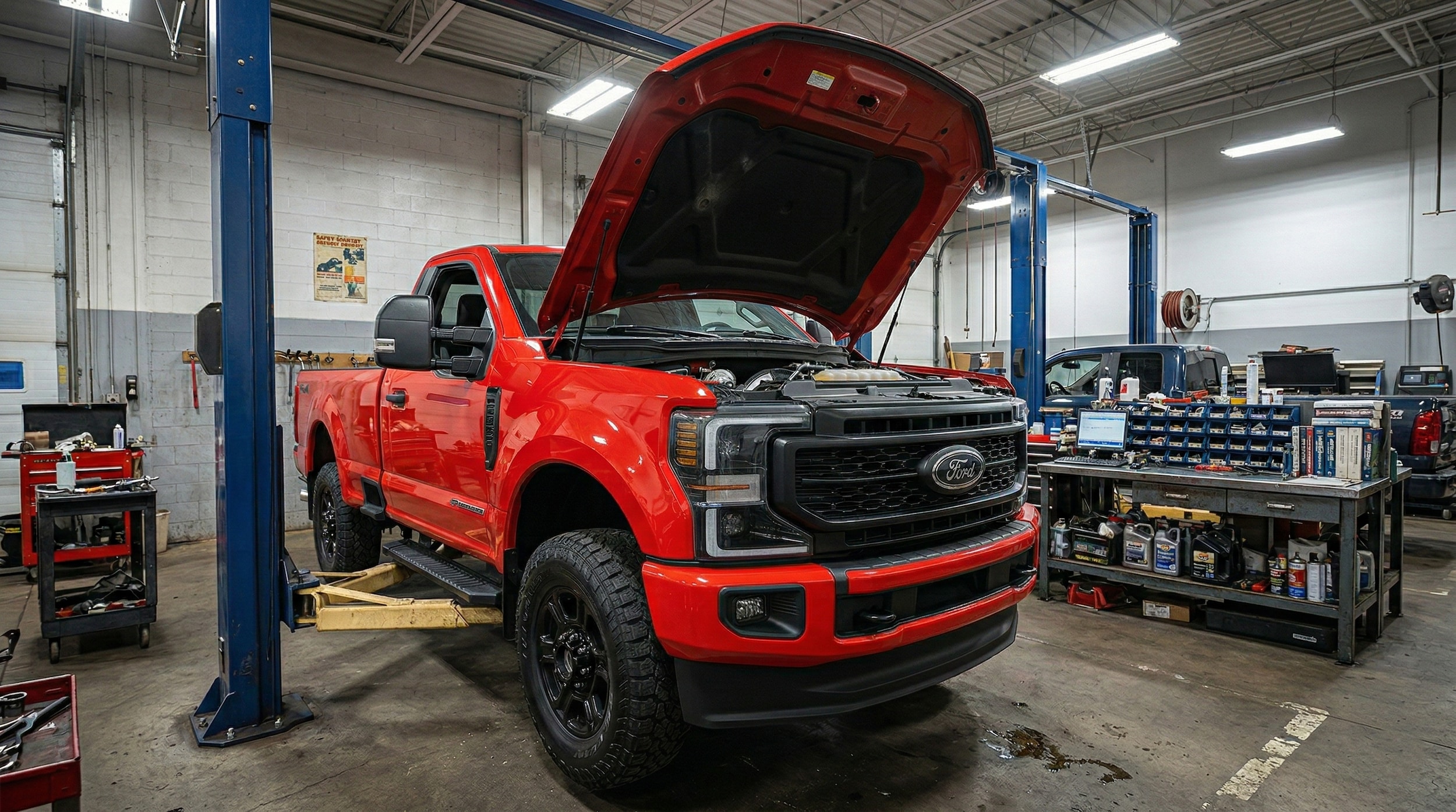
If you have been shopping for a Super Duty lately around Lancaster County, you have probably noticed a new player in the lineup. While everyone talks about the 7.3L Godzilla, there is a younger brother on the scene: the 6.8L V8, often called the Mini Godzilla.
This engine hit the streets in 2023, originally tucked away in the XL work trucks. Now that it is becoming the standard base engine for most F-250s and F-350s, it is time to look at what makes this motor tick and where it might leave you wanting more. Here is the breakdown of what I love and what I really don't about this powerplant.
5 Things I Love About the Mini Godzilla
1. Old School Simplicity
In an era where every engine feels like a giant computer with pistons, the 6.8L is a breath of fresh air. It is a straightforward, overhead valve V8. When you pop the hood, you can actually see the ground. There is a ton of room to work, which is a dream for anyone who does their own maintenance or wants to add some modifications down the road. It feels like a throwback to the days when engines were built to be workhorses first and gadgets second.
2. Port Injection Fuel System
One of the best design choices Ford made here was sticking with port injection. A lot of modern gas engines use direct injection or a complex dual setup that runs at incredibly high pressures. The 6.8L runs a low-pressure system, usually between 50 and 60 PSI. Compare that to the thousands of PSI in a diesel or high-performance gas motor, and you have got a lot less stress on the components. Lower pressure generally translates to fewer leaks, fewer failures, and a longer life when you are beating on the truck every day.
3. No Turbos, No Problems
Ford currently owns the crown for the two largest displacement V8s on the market with the 7.3L and this 6.8L. While companies like Toyota are moving toward twin-turbo V6 setups, Ford is sticking to the "no replacement for displacement" philosophy. You get 405 horsepower and 445 lb-ft of torque without the complexity of turbochargers. It is just raw V8 power that is ready to work without waiting for boost.
4. Surprising Fuel Economy
Nobody buys a Super Duty to save the planet, but every bit helps at the pump. Real-world reports from owners show the 6.8L averaging between 13 and 16 miles per gallon. When you compare that to the 10 to 14 MPG usually seen with the bigger 7.3L, those savings add up over a year of driving. It is a nice middle ground for the guy who needs the heavy-duty frame but wants to keep the fuel bill somewhat manageable.
5. Overbuilt Cooling System
Here is a little secret: the 6.8L uses the exact same cooling system as the much larger 7.3L. Because this engine has a shorter stroke and produces less heat, that cooling system is technically overkill. It means your truck is going to cool down faster and stay at its optimal temperature longer, even when you are pulling a heavy load up a grade in the middle of summer.
5 Things I Hate About the Ford 6.8L V8
1. Why Does This Even Exist?
The 6.8L is so similar to the 7.3L that you have to wonder why Ford spent the millions of dollars to develop a second, separate engine. It requires its own assembly line and different parts. It feels like a bit of a waste of resources when they already had a legendary engine in the Godzilla. It seems like a lot of effort just to create a "base" option.
2. The Pricing Makes No Sense
This is the biggest kicker. On a new truck, you can upgrade from this 6.8L to the 7.3L Godzilla for only about $1,500. For an individual buyer, that is a drop in the bucket compared to the total price of a Super Duty. Unless you are a fleet manager buying 50 trucks at a time to save a chunk of change, it is hard to justify choosing the smaller engine when the big brother is so affordable.
3. The Lighter-Duty Transmission
When you opt for the 6.8L, you aren't just getting a smaller engine; you are getting a different transmission. This motor is paired with the 10R100 TorqShift-G, which is a lighter-duty version of Ford's 10-speed. The 7.3L gets the 10R140, which is the same heavy-duty unit used in the high-torque diesel trucks. For that same $1,500 upgrade mentioned above, you are getting a much beefier transmission along with the extra power.
4. Significant Towing Gap
If you are planning on hauling heavy, the 6.8L might hold you back. In a standard F-350 configuration, the 6.8L is rated for about 14,300 lbs. If you had that 7.3L under the hood, that number jumps up to 18,200 lbs. Giving up nearly 4,000 lbs of towing capacity is a tough pill to swallow, especially when the price difference between the two engines is so small.
5. The Variable Displacement Oil Pump
Ford decided to use a variable displacement oil pump on this engine to chase a tiny bit of fuel efficiency—maybe 1% or 2%. The problem is that these pumps provide oil "on demand" rather than at a constant volume. On a work truck that is meant to be pushed to its limits, most owners would much rather have a constant-volume, "dumb" oil pump that just keeps everything lubricated regardless of what the computer thinks about fuel economy.
Is the Mini Godzilla Right for You?
At the end of the day, the 6.8L is a solid, reliable engine that will likely last a very long time. It makes a ton of sense on the used market where the price gap might be wider, or for fleet owners looking to shave every penny. But if you are buying new, it is hard not to look at that 7.3L and think it is the better deal.
Check out the full video below to see this F-350 in action and hear more about the Mini Godzilla!
https://www.youtube.com/watch?v=BViXawmpFdo