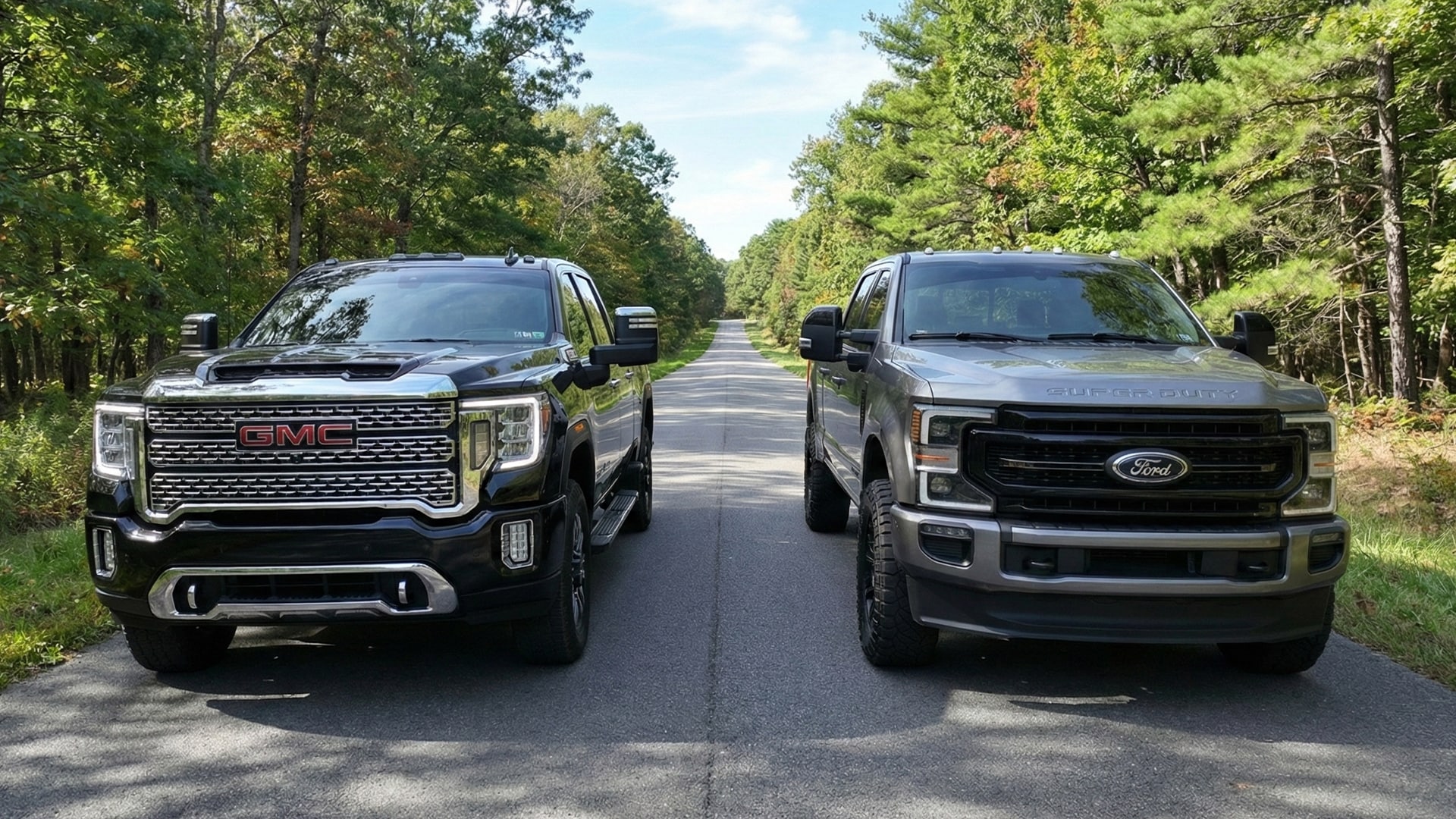
If you are in the market for a heavy-duty diesel truck in 2024, you are likely looking at the two heavyweights of the industry: the General Motors 6.6L Duramax (found in the Chevy Silverado 2500/3500 and GMC Sierra) and the Ford 6.7L Power Stroke (found in the F-250 and F-350).
These are the two best-selling diesel platforms in the United States. While both are absolute monsters capable of hauling just about anything you throw at them, they have distinct personalities.
In this comparison, we break down the specs, the design differences, fuel economy, and the all-important daily driving experience to help you decide which one belongs in your driveway.
Quick Specs: Head-to-Head
Before we dive into the details, let's look at the raw numbers for the 2024 models.
1. Engine Architecture: Over-Square vs. Under-Square
One of the most interesting technical differences between these two is the bore-to-stroke ratio, which fundamentally changes how they make power.
The GM Design (Over-Square)
The Duramax is an "Over-Square" engine.
-
Bore: 4.05 inches
-
Stroke: 3.89 inches
Because the stroke is shorter than the bore, the engine has less mechanical leverage, meaning less natural torque. While GM has done an incredible job with the turbo and tuning to reach 975 lb-ft, the engine is physically torque-limited compared to the Ford.
The Ford Design (Under-Square)
The Power Stroke is an "Under-Square" engine.
-
Bore: 3.89 inches
-
Stroke: 4.25 inches
With a significantly longer stroke, the Ford engine produces more natural torque. This design allows Ford to push out 1,050 lb-ft in the standard output and a massive 1,200 lb-ft in the High Output version. If raw pulling power is your only metric, the Ford wins on paper.
2. Fuel Economy and DEF Usage
When it comes to efficiency, the Ford Power Stroke generally edges out the GM Duramax, but there is a catch regarding Diesel Exhaust Fluid (DEF).
-
Fuel Economy: The Ford typically sees 1-2 mpg better than the GM in almost all scenarios (city, highway, and towing). Towing a heavy camper, the Ford High Output can manage 10-11 mpg, whereas the Duramax often sits in the 7-9 mpg range.
-
DEF Consumption: The Ford is thirsty for DEF. If you buy the Power Stroke, keep a jug of DEF handy because it consumes fluid much faster than the GM system.
Range Note: GM only offers a 36-gallon tank. Ford offers a 34-gallon tank on short beds, but a massive 48-gallon tank on long beds (8ft), giving Ford the win for long-haul range.
3. Reliability and Known Issues
No truck is perfect. Here is what you need to watch out for on the 2024 models.
GM Duramax Issues
-
MAP Sensors: A common annoyance on the newer models. It is recommended to pull the MAP sensor every 5,000 miles (or every oil change) and clean it to prevent code errors.
-
Powertrain Warranty: GM offers a 5-year/60,000-mile powertrain warranty, likely because they are confident the hard parts will hold up better than the sensors/tech.
Ford Power Stroke Issues
-
CP4 Fuel Pump: Ford still utilizes the Bosch CP4 fuel pump. This is a point of contention, as both GM and Ram moved away from this pump due to past failures where the pump would disintegrate and send metal shavings through the fuel system. While current Ford failure rates aren't catastrophic, it is a design constraint to be aware of.
4. The Drive: Comfort vs. Capability
This is the deciding factor for many buyers. Since you have to drive this truck every day, how it feels on the road matters.
-
The GM Advantage: Thanks to its Independent Front Suspension (IFS), the GM trucks ride smoother, handle better, and feel more like a large car or SUV. There is less "wander" on the highway. It is widely considered the smoothest-driving diesel in its class.
-
The Ford Feel: Ford uses a Solid Front Axle. While this is great for durability and off-roading, it translates to a stiffer ride and more steering wander on the highway. It feels like a traditional heavy-duty truck.
The Verdict: Which One Should You Buy?
If you look strictly at the spec sheet, the Ford Power Stroke is the winner. It has more horsepower, significantly more torque, higher towing capacity, better fuel economy, and the option for a larger fuel tank.
However, specs aren't everything.
The GM Duramax is frequently chosen as the favorite for daily driving. The engine and transmission pairing is incredibly smooth, and the ride quality provided by the independent front suspension makes it a much more comfortable vehicle for long family trips or daily commutes.
Bottom Line:
-
Buy the Ford if you need maximum torque, the High Output option, or better fuel range.
-
Buy the GM if you want the best driving experience, superior handling, and a truck that is comfortable enough to drive every single day.
Watch the Full Breakdown
Want to see these trucks in action and hear more about the technical details? Check out the full video below:
https://www.youtube.com/watch?v=szQIuMq4xpM