
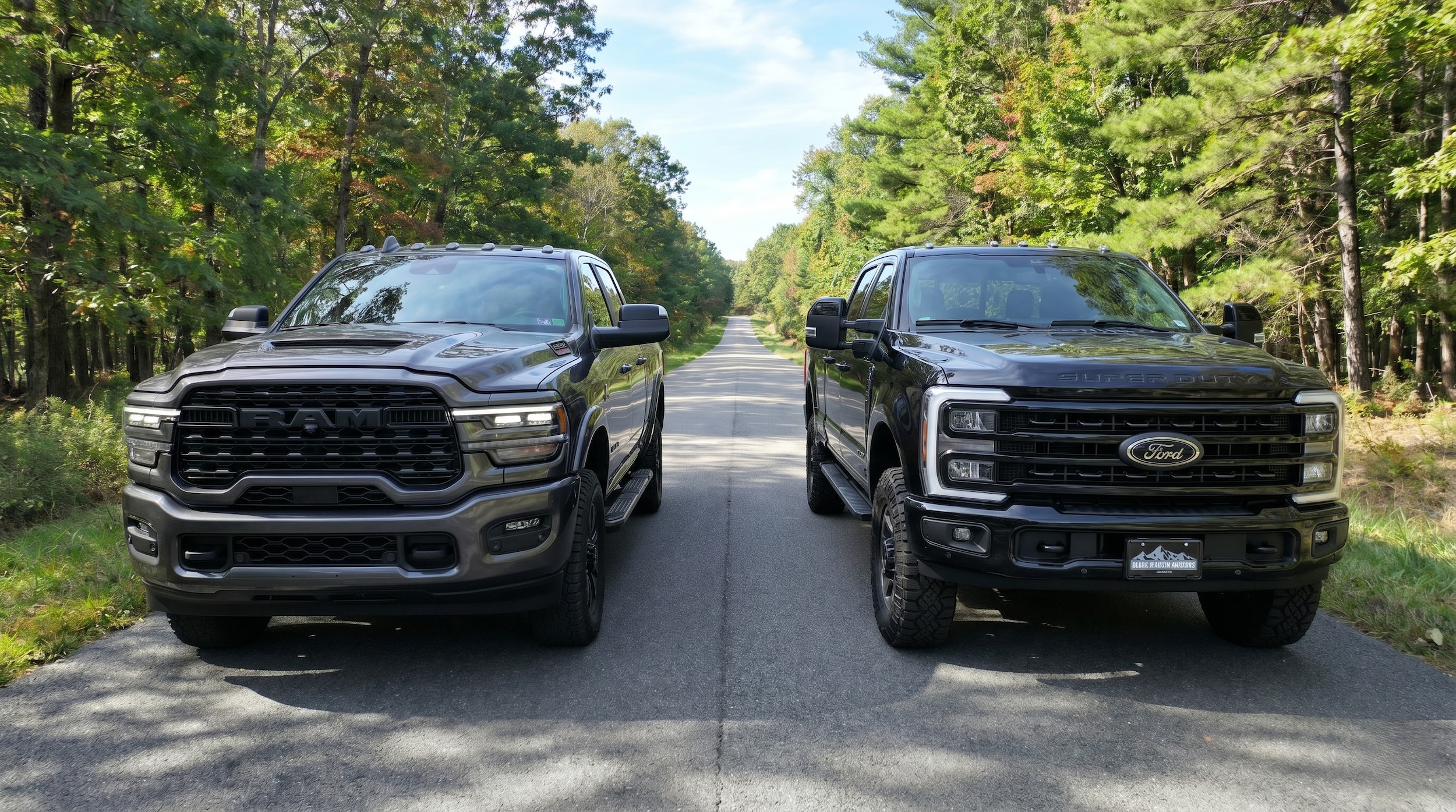
 If you have been keeping an eye on the heavy duty truck market lately, you know the power wars are reaching some pretty wild heights. Being right here in Ephrata, I get to see a lot of these trucks roll through the lot, and I finally got my hands on a 2025 Ram High Output to put side-by-side with the Ford 6.7 High Output.
Whether you are hauling equipment out to a job site in Lancaster or taking the camper across the state, choosing the right power plant is a massive decision. We traded for this 2025 Ram recently, and since I have spent some time in the Fords, I wanted to break down what actually makes these two engines different.
The Specs: Inline 6 vs. The V8
Right out of the gate, we are looking at two very different philosophies under the hood.
The Ram features the legendary 6.7L Cummins inline 6-cylinder turbo diesel. It is putting out 430 horsepower and 1,075 lb-ft of torque. Now, compare that to the Ford 6.7L Power Stroke High Output. The Ford is a V8 turbo diesel churning out a massive 500 horsepower and 1,200 lb-ft of torque.
When you drive them, you can feel that 70 horsepower difference immediately. The Ford honestly rips like a race car—it is built for raw power. The Ram, on the other hand, feels like a slower, more deliberate build-up. It is a workhorse through and through, focused more on consistent delivery than a quick spike.
Bore, Stroke, and Power Delivery
One of the main reasons they feel so different comes down to the internal design. The Cummins uses a longer stroke, which means the piston travels further. This gives the engine more leverage and incredible low-end torque. It feels like it can pull forever.
The Power Stroke is a bit more balanced, which allows it to reach higher RPMs and deliver that power much faster. If the Cummins is the steady marathon runner, the Ford is the sprinter that hits hard right out of the gate.
Fuel Systems and Turbochargers
Both of these trucks utilize high-pressure common rail fuel systems, but Ford runs a higher injection pressure. This leads to a cleaner, more precise combustion, which is part of how they squeeze out those higher performance numbers.
When it comes to the turbos, the Cummins uses a Holset VGT (Variable Geometry Turbo) known for its durability and steady boost. Ford uses a Garrett VGT, which is designed for a faster spool and quicker response time. Again, it goes back to that feeling: Ram is consistent; Ford is a spike.
Maintenance and Long-Term Reliability
As an SEO pro who spends all day looking at truck data and a local who talks to owners every day, I have to mention the "workability" of these engines.
If you pop the hood on the Ram, you actually have space to move. With that straight-six design, there is room around the engine to get your hands in there if you like doing your own maintenance. You look at the Ford, and it is jam-packed. There is almost zero empty space in that engine bay.
Heat Management Concerns
Because the Ford is pushing so much more horsepower and torque, it generates a ton of heat. Managing that heat in such a crowded engine bay is a complex task. Over the long haul, that extra heat and complexity can mean a higher risk of wear and tear compared to the simpler, cooler-running Cummins setup.
The Ford has two cylinder heads while the Ram just has one long one. It is a sweet piece of engineering, but the more you have going on, the more you have to stay on top of your maintenance schedule to keep it on the road.
Real World Efficiency and DEF Usage
Since these are heavy duty trucks, you won't see an official EPA rating, but we see the real-world numbers from our customers every day.
-
Ford 6.7 HO: Expect about 17-20 MPG on the highway and 8-12 MPG while towing.
-
Cummins HO: You'll see around 16-19 MPG on the highway, but it shines in towing at 9-13 MPG.
The bigger difference for your wallet might actually be the Diesel Exhaust Fluid (DEF). The Ford High Output drinks DEF, especially when you have a trailer hooked up. You’re looking at a tank every 3,000 to 5,000 miles. The Ram is much more efficient here, often going 5,000 to 7,000 miles on a single tank. If you're heading out on a long haul from Ephrata, you might want to keep an extra jug of DEF in the back of the Ford just in case.
Transmissions: The Aisin vs. The 10-Speed
The engine is only as good as the transmission it’s paired with. The Ford uses its in-house 10-speed transmission, which offers fast shifts and keeps that power right on hand.
The Ram High Output comes with the Aisin transmission. It is a bit slower and heavier, but it is built for the most demanding commercial-grade work. It reinforces that "workhorse" feel of the Cummins.
Which One Should You Choose?
It really comes down to what you value in a truck.
-
Pick the Ford High Output if you want maximum capacity, incredible acceleration, and a truck that is a blast to drive. Just be prepared to stay very disciplined with your maintenance.
-
Pick the Cummins High Output if you want a durable, commercial-grade workhorse with a gradual power curve that can handle heavy loads day-in and day-out for years.
I see guys around here who swear by one and wouldn't be caught dead in the other. At the end of the day, both are incredible machines that have pushed the industry forward.
Check out the full breakdown in the video below: