
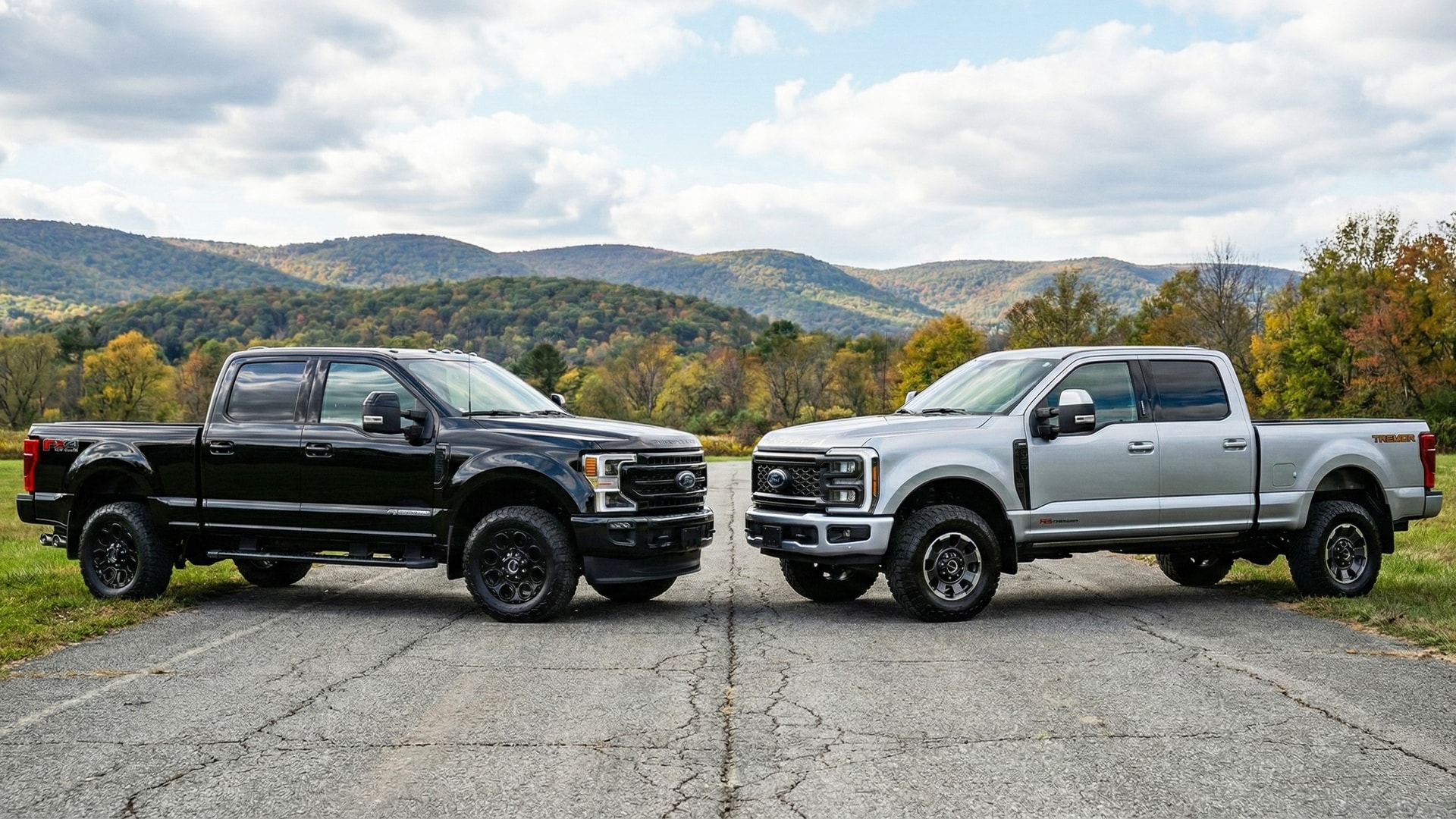
If you’ve ever stood on a dealership lot staring at a Ford Super Duty F-250 and an F-350, wondering what actually separates them besides the badge on the fender, you aren't alone.
These trucks can look nearly identical, yet their capabilities can vary wildly depending on how they are configured. Following a similar deep dive into GM trucks, we decided to research the actual nuts and bolts of the 2023 Ford Super Duty lineup. How are these trucks equipped, what do the packages look like, and how does an F-250 really stack up against an F-350?
The reality is confusing because you can configure these trucks in so many different ways. Here is a breakdown of the real differences to help you understand what you’re looking at.
What Stays the Same?
Before diving into the differences, it’s important to note just how much these two heavy-duty trucks share. Whether you choose the F-250 or the F-350, you have access to the same fundamental building blocks:
-
Trim Levels: From XLT to Lariat and Platinum, the interior luxury and tech options are available on both.
-
Engines: You get the same powertrain lineup. According to the transcript, this includes standard gas engines like the 6.2L and the 7.3L Godzilla, plus the diesel options: the standard 6.7L Power Stroke and the High Output 6.7L Power Stroke.
-
Transmissions: You aren't getting a "better" transmission on the F-350; both trucks utilize the same 10-speed automatic transmission.
-
Configurations: Bed lengths (6'8" or 8') and wheel/tire options are largely shared across both models.
The Visual Hardware Difference: Suspension and Axles
If you crawl underneath the rear of these trucks, you will usually find the most significant physical difference.
-
F-350 Leaf Springs: Typically, the F-350 features a stouter setup with basically three main leaf springs plus a distinct helper spring.
-
F-250 Leaf Springs: The standard F-250 setup usually has two main leaf springs and lacks that extra helper spring found on the 350.
The Crucial Exception: This is where it gets tricky. You can get an F-250 with the exact same rear suspension setup as an F-350. If you order an F-250 with the Tremor off-road package, it comes equipped with the same rear suspension hardware as the F-350 Tremor.
Furthermore, when equipped for maximum towing, the only deep-dive hardware differences are minor. The F-250 uses a 3.5-inch axle tube, while the F-350 uses a 4-inch axle tube with a thicker axle shaft and higher spline count. Otherwise, they are nearly identical structurally.
Deciphering GVWR and Towing Capacities
Because the hardware can be so similar, the biggest difference often boils down to the sticker on the door jamb: the Gross Vehicle Weight Rating (GVWR). This rating dictates what the truck is legally and safely rated to tow and haul.
The video compared two specific Lariat models to highlight this:
The "Light" F-250 Lariat
This specific F-250 was equipped with an optional 9,900 lb GVWR package. This is often chosen to stay under commercial weight restrictions or for insurance reasons. It featured the 3.31 electronic locking rear axle (the lowest available ratio).
-
Conventional Towing: 15,800 lbs
-
5th Wheel Towing: 14,200 lbs
-
Gooseneck Towing: 15,300 lbs
-
Note: An F-250 equipped with the Tremor package, 3.55 axle, and HO motor bumps conventional towing significantly to 18,200 lbs.
The F-350 Lariat Tremor HO
This F-350 featured the High Output diesel and the Tremor package, with a significantly higher 12,000 lb GVWR.
-
Conventional Towing: 18,200 lbs (Interestingly, this is the same conventional rating as a maxed-out F-250 Tremor).
-
5th Wheel/Gooseneck Towing: Jumps up to 23,000 lbs.
It's worth noting that a non-Tremor F-350 can actually tow even more, with conventional ratings hitting nearly 24,000 lbs, because the off-road suspension doesn't limit it.
Payload: The Safety Factor
Where the F-350 almost always wins is payload capacity—the combined weight of occupants and cargo you can put in the truck.
Because of regulations and safety ratings from the factory, the F-350 is rated to carry more weight on its axles.
-
The 9,900 GVWR F-250 example had a cargo capacity rating of only 1,743 lbs.
-
The F-350 Tremor example had a cargo capacity rating of over 3,600 lbs (depending on specific sticker adjustments).
From a safety and legal perspective, if you are hauling heavy campers or heavy equipment in the bed, the F-350 is the safer bet to ensure you are not overweight in the event of an accident or a roadside check.
The Final Verdict: Check the Sticker
The bottom line on the 2023 F-250 versus the F-350 is that you cannot generalize. You can build an F-250 that is mechanically very similar to an F-350.
However, the official weight rating on the door sticker dictates your legal limits. To know exactly what a specific truck can safely tow and haul, you have to look at that truck's specific configuration and VIN sticker.
Watch the full breakdown and comparison in the video below: https://www.youtube.com/watch?v=6It_jPhGug0